
You can have the best BLDC motor on the market, but if you pair it with the wrong controller, your drone will not fly well, or it will not fly at all. The controller is the brain of your propulsion system. Get it right and everything else follows.
This guide walks you through everything you need to know about BLDC motor controllers: what they do, the key specifications to match, the difference between 24V and 48V systems, and how to avoid the most common pairing mistakes.
1. What is a BLDC motor controller? | 2. How does an ESC work? | 3. Key specs explained | 4. 24V vs 48V systems | 5. Controller types | 6. How to match controller to motor | 7. EU sourcing considerations | 8. FAQ
What Is a BLDC Motor Controller?
A BLDC motor controller, commonly called an ESC (Electronic Speed Controller) in the drone world, is the electronic device that sits between your battery and your motor. It converts the DC power from your battery into the precise, timed electrical pulses that the motor needs to spin.
Without a controller, a BLDC motor cannot run. The controller handles electronic commutation — the process of switching current between the three motor phases in the right sequence at the right moment to keep the rotor spinning smoothly.
KEY TERM | Electronic commutation: Switching electrical current between the three motor phases in a timed sequence to create continuous rotation. In brushed motors, physical brushes do this mechanically. In BLDC motors, the controller does it electronically — faster, cleaner, and without wear. |
How Does an ESC Work?
The sequence that happens every time your motor runs:
- Your flight controller sends a throttle signal to the ESC.
- The ESC reads its rotor position data — from Hall effect sensors or back-EMF detection.
- It uses this data to fire the three motor phases in the correct order.
- The timed magnetic fields pull and push the rotor’s permanent magnets, creating rotation.
- The ESC adjusts the phase timing thousands of times per second to maintain the commanded speed.
Modern ESCs do this using a technique called PWM (Pulse Width Modulation), or increasingly, DSHOT — a fully digital protocol that eliminates timing errors and allows bidirectional communication between the ESC and the flight controller.

Key Specifications Explained
When comparing BLDC motor controllers, these are the numbers that matter most for drone applications:
Continuous Current Rating (Amps)
This is the most important spec. It tells you the maximum current the ESC can handle continuously without overheating. Always choose an ESC rated higher than your motor’s maximum continuous current draw. A common rule of thumb: ESC rated at 20–30% more than the motor’s max current.
IMPORTANT: Never match your ESC current rating exactly to your motor’s peak draw. Peak currents during throttle spikes can be significantly higher than continuous ratings. An ESC running at its current limit will overheat and fail.
Voltage Rating
ESCs are rated for specific voltage ranges, typically expressed as a cell count (e.g. 4S, 6S, 12S) or a voltage range (e.g. 16–48V). Your battery voltage must fall within this range. The two most common system voltages for commercial UAVs are:
- 24V systems (6S LiPo) — common in mid-size inspection and survey drones
- 48V systems (12S LiPo or 14S LiHV) — standard in heavy-lift platforms and longer endurance commercial UAVs
PWM Protocol Support
Your ESC must support the same communication protocol as your flight controller. Modern protocols include:
- Standard PWM — widely compatible, but lower resolution and subject to timing noise
- DSHOT150 / DSHOT300 / DSHOT600 — digital, noise-immune, faster; recommended for precision UAV work
- UAVCAN / DroneCAN — used in higher-reliability commercial and defence-adjacent platforms
BEC Included or Separate?
A BEC (Battery Elimination Circuit) steps down the main battery voltage to power your flight controller and peripherals. Some ESCs include a built-in BEC; others do not. For multi-rotor builds, a separate BEC or power distribution board is typically used to avoid noise interference.
Sensorless vs Sensored Operation
Most drone ESCs run sensorless — they detect rotor position using back-EMF instead of Hall effect sensors. Sensored controllers (which require Hall-sensor-equipped motors) offer smoother low-speed performance but add wiring complexity. For most UAV applications, high-quality sensorless ESCs are the preferred choice.
24V vs 48V BLDC Motor Controllers: Which Should You Choose?
Voltage selection has a significant impact on system efficiency, cable weight, and component choice. Here is a direct comparison:
| 24V BLDC Controller (6S) | 48V BLDC Controller (12S/14S) |
Typical platform | Mid-size survey / inspection drones | Heavy-lift, long-endurance commercial UAVs |
Current for same power | Higher (more cable heat) | Lower (more efficient cabling) |
Component availability | Wide — many ESC options | Growing — fewer options, often more capable |
Motor selection | Broad market options | Higher KV motors or rewound for 48V |
Cable weight | Heavier for equivalent power | Lighter — critical for larger platforms |
Typical use case | Platforms up to ~5 kg MTOW | Platforms 5–25 kg+ MTOW |
RULE OF THUMB: At equivalent power levels, doubling the voltage halves the current. Halving the current means you can use thinner, lighter cables — which matters significantly in UAV weight budgets. Most commercial UAV programmes above 5 kg MTOW are moving toward 48V systems for this reason.
Types of BLDC Motor Controller for Drones
Single-channel ESC (per-motor)
One ESC per motor. The standard approach for multi-rotor drones. Each motor gets its own dedicated controller, simplifying troubleshooting and allowing independent motor replacement. Most commercial quadrotors, hexarotors, and octorotors use this configuration.
3-phase BLDC motor controller (integrated)
A 3-phase BLDC controller handles the three motor winding phases directly, either as a standalone unit or integrated into a power distribution and control system. For larger UAV platforms and fixed-wing aircraft, integrated 3-phase controllers offer higher power handling and often include telemetry, current monitoring, and CAN bus communication.
4-in-1 ESC
A single board containing four ESCs, designed for compact multi-rotor builds. Saves weight and space. Popular in professional-grade inspection drones where every gram counts. The trade-off is that a single failure takes out all four motor channels.

How to Match a Controller to Your BLDC Motor
Getting the pairing right is straightforward if you work through these steps in order:
Step 1: Find your motor’s maximum continuous current
This is listed in the motor datasheet. If it is not listed, contact the manufacturer. You need this number before you can choose an ESC.
Step 2: Choose an ESC with 20–30% current headroom
If your motor draws a maximum of 30A continuous, select an ESC rated for at least 36–40A continuous. This gives you thermal headroom during sustained high-throttle operation.
Step 3: Match the voltage range
Check that the ESC’s input voltage range covers your battery configuration. A 48V (12S) system needs an ESC rated to at least 50V continuous, preferably higher.
Step 4: Confirm protocol compatibility
Check that your flight controller and ESC speak the same protocol. If you are using ArduPilot or PX4, DSHOT is supported natively. DroneCAN/UAVCAN is required for some higher-end commercial flight controllers.
Step 5: Check physical size and mounting
ESC dimensions matter in tight UAV frames. Check the PCB footprint, connector type, and mounting hole pattern against your airframe before ordering.
PRO TIP: Always test your ESC-motor combination under load before flight, using a motor test stand if possible. Log the temperature of the ESC after a sustained full-throttle run of 30–60 seconds. If it exceeds 80°C, you need more current headroom or better airflow.
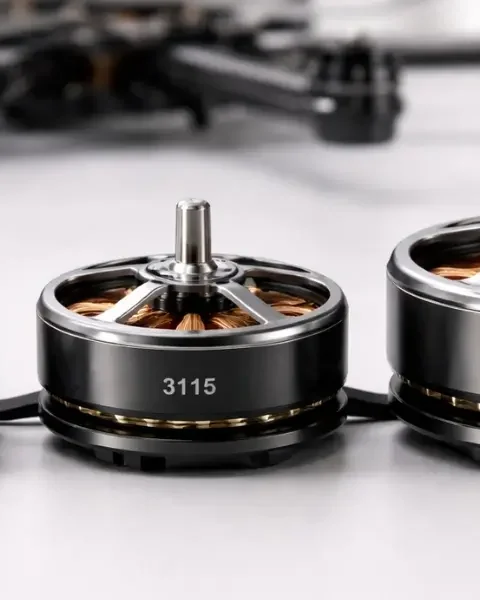
Looking for a compatible motor? See our 3110 BLDC motor — designed and manufactured in Europe for commercial UAV applications, with published current and thermal data for each variant.
EU Sourcing Considerations for BLDC Motor Controllers
For European UAV OEMs, the motor controller supply chain deserves the same scrutiny as the motor itself. Most ESCs available in the hobby and commercial market originate from a small number of manufacturers in China. This creates familiar supply chain risks: long lead times, batch quality variation, limited technical documentation, and compliance uncertainty.
For programmes operating in defence-adjacent, critical infrastructure, or public safety roles, supply chain provenance is increasingly a procurement requirement — not just a preference.
Centrion Systems’ approach to EU supply security for UAV components covers motor controllers alongside motors — including lot traceability, compliance documentation, and guaranteed lead time commitments for qualified OEM customers.
Browse our motor controller product range to see current-rated, voltage-matched options for 24V and 48V UAV platforms.
Frequently Asked Questions
What is the difference between a BLDC motor controller and an ESC?
They are the same thing described with different terminology. ESC (Electronic Speed Controller) is the term used in the drone and RC hobby world. BLDC motor controller is the more technical and industrial term. Both refer to the electronic device that manages power delivery to the motor phases.
Can I use any ESC with any BLDC motor?
No. The ESC must be compatible with the motor’s voltage range and current draw. It must also support the same communication protocol as your flight controller. Mismatching voltage or current ratings is one of the most common causes of ESC failure and motor damage.
What does a 48V BLDC motor controller offer over a 24V model?
At equivalent power levels, a 48V system draws half the current of a 24V system. Lower current means less resistive loss, cooler cables, and the ability to use lighter gauge wiring. For UAV platforms above ~5 kg, the weight and efficiency gains from a 48V system are significant over the life of the programme.
What is a 3-phase BLDC motor controller?
All BLDC motors are inherently 3-phase: they have three sets of stator windings that must be energised in sequence. A 3-phase BLDC motor controller is simply a controller that manages these three phases. The term is used more often in industrial contexts; in drone applications, the same device is typically called an ESC.
Do I need a sensored or sensorless ESC for my drone?
For most drone applications, a high-quality sensorless ESC is the correct choice. Sensorless ESCs detect rotor position via back-EMF, eliminating the Hall sensor wiring that adds weight and failure points. Sensored operation is more relevant for very low-speed or high-torque applications like e-bikes or CNC spindles, rather than drone propulsion.
Summary
Choosing the right BLDC motor controller for your drone comes down to matching four things correctly: current rating, voltage range, protocol compatibility, and physical form factor. Get those four right, and your propulsion system will perform reliably.
For European UAV OEMs building platforms that need supply chain traceability and consistent component quality, the controller deserves the same sourcing discipline as the motor.