
You have probably heard that a BLDC motor has no brushes. But what parts does it actually have? And what does each part do?
This guide breaks down every component inside a BLDC motor in plain language. Whether you are building a drone, selecting a motor for your UAV platform, or just trying to understand the technology, this guide will give you a clear picture.

Overview: What Parts Does a BLDC Motor Have?
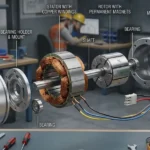
A BLDC motor is made up of a small number of core parts. Each one plays a specific role in converting electrical energy into rotation.
| Component | What It Does |
|---|---|
| Stator | The fixed outer part that holds the copper wire coils |
| Rotor | The spinning part that carries the permanent magnets |
| Windings | Copper wire coils wound around the stator that create magnetic fields |
| Permanent Magnets | Magnets on the rotor that react to the stator's magnetic fields |
| Bearings | Allow the rotor to spin smoothly with minimal friction |
| Controller (ESC) | Manages the timing and sequence of current to the coils |
| Hall Effect Sensors | Detect rotor position and send feedback to the controller |
| Motor Housing | The outer shell that holds everything together and protects it |
QUICK FACT | Most BLDC motors used in drones and UAVs have just 5 physical parts: stator, rotor, magnets, bearings, and a housing. The controller sits outside the motor as a separate unit. |
The Stator
The stator is the stationary part of the motor. It sits on the outside of the motor (in an outrunner design) or on the inside (in an inrunner design).
The stator is made from thin sheets of electrical steel, called laminations, stacked together. This design reduces energy losses caused by magnetic fields passing through the metal.
What does the stator do?
The stator holds the copper wire coils (the windings). When electricity flows through these coils, they become electromagnets. By switching which coils are active and in what order, the controller creates a rotating magnetic field that pulls the rotor around.
How is stator size measured?
Stator size is written as a 4-digit number. For example, 3110 means the stator is 31mm wide and 10mm tall. The width affects torque output and the height affects power capacity.
- Wider stator: More torque, better for heavy-lift applications
- Taller stator: Higher power output
- Compact stator: Lighter weight, better for small fast drones
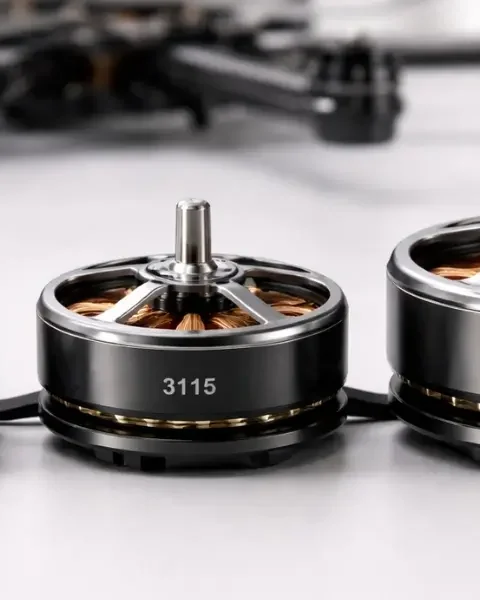
Centrion Systems produces motors in 3110, 3115, and 5006 stator sizes. Each is optimised for different UAV payload and flight requirements. See the full motor range here.
DESIGN NOTE | Drone motor stators are typically wound with thin copper wire to reduce resistance and heat. The number of slots in the stator (commonly 12) affects how smooth the rotation feels at low speeds. |
The Rotor
The rotor is the spinning part of the motor. In an outrunner BLDC motor (the most common type for drones), the rotor is the outer bell-shaped casing that rotates around the fixed stator.
The rotor carries the permanent magnets evenly spaced around its inner surface. These magnets face inward toward the stator coils.
Inrunner vs outrunner rotor
Rotor Type | Description |
Outrunner | The rotor shell spins around the outside of the stator. Produces higher torque at lower RPM. Standard for drones and UAVs. |
Inrunner | The rotor shaft spins inside the stator. Produces very high RPM. Used in RC cars, turbochargers, and fast-spinning applications. |
Rotor material and weight
Drone rotors are usually machined from aluminium to keep weight low. Some high-performance rotors use carbon fibre composite for even better weight savings. The lighter the rotor, the faster the motor can change speed, which matters a lot for drone stability and control.
Motor Windings
The windings are the copper wire coils wound around the stator teeth. They are one of the most important parts of any BLDC motor because they directly determine the motor’s efficiency, heat output, and torque characteristics.
How windings work
When electrical current flows through a winding, it creates a magnetic field around that coil. The strength and direction of this field depends on the amount of current and the direction it flows.
The controller switches current through different windings in a specific sequence. This creates a rotating magnetic field that the rotor’s permanent magnets follow, causing the rotor to spin.
3-phase winding
Most BLDC motors use a 3-phase winding system. This means there are three separate sets of coils, labelled Phase A, Phase B, and Phase C. The controller energises these phases one after another in a precise pattern.
Using three phases instead of one produces smoother rotation and more consistent torque. It also means there is always at least one phase actively pulling the rotor forward, which reduces vibration.
Winding wire gauge
The thickness of the copper wire affects how much current the motor can handle. Thicker wire can carry more current with less resistance, which means less heat. Thinner wire allows more turns in the same space, which can increase torque but also raises resistance.
WINDING TIP | In UAV motors, the winding resistance (measured in milliohms) is often listed in the spec sheet. Lower resistance means less heat at high current and better efficiency. Centrion Systems motors are wound with high-temperature rated copper wire to handle demanding flight conditions. |
Permanent Magnets
The permanent magnets are fixed to the inside surface of the rotor bell. They do not need any electrical power because they are always magnetised.
Most high-performance BLDC motors use neodymium iron boron (NdFeB) magnets. These are among the strongest permanent magnets available for their size and weight.
Curved magnets for better performance
In well-designed motors, the magnets are curved to match the shape of the stator. This increases the contact area between the magnetic field and the stator windings, which improves efficiency and produces smoother torque.
Centrion Systems 3110 and 3115 motors use N52H grade curved neodymium magnets, which maintain their magnetic strength at temperatures up to 120 degrees Celsius. This is important in demanding drone applications where motors heat up during sustained flight.
Number of magnet poles
The number of magnets (poles) affects motor behaviour. More poles generally mean higher torque at lower RPM, which is ideal for large propellers. Most drone BLDC motors have 14 poles (written as 14P).
Pole Count | Effect on Motor Behaviour |
Low poles (e.g. 4P) | Higher RPM, lower torque, suits small fast props |
Medium poles (e.g. 8P or 12P) | Balanced performance for mid-size UAVs |
High poles (e.g. 14P or 16P) | Higher torque, lower RPM, suits large heavy-lift props |
Bearings
Bearings are small but critical. They allow the rotor to spin smoothly around the stator shaft with as little friction as possible.
Most BLDC drone motors use two bearings, one at the top of the motor and one at the bottom. The quality of these bearings has a direct effect on how long the motor lasts and how smoothly it runs.
Bearing types
Ball bearings are the most common type in drone motors. They contain small metal balls that roll between two rings, reducing friction to a very low level.
- Standard ball bearings: Used in most consumer and commercial drone motors
- Stainless steel bearings: Resist corrosion, used in marine or humid environments
- Ceramic hybrid bearings: Lighter and harder than steel, used in high-performance racing motors
When do bearings need replacing?
Bearings are usually the first thing to wear out in a BLDC motor. Signs that bearings need attention include:
- A grinding or rattling noise from the motor
- Vibration that was not present when the motor was new
- The rotor feels rough when spun by hand
- Reduced efficiency or unusual heat from the motor
Replacing bearings is far cheaper than replacing the whole motor. For professional UAV platforms, scheduled bearing inspection is part of a standard maintenance programme.
The Controller (ESC)
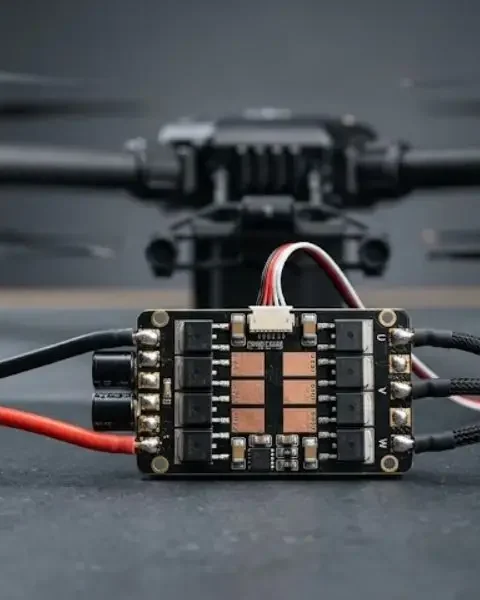
The Electronic Speed Controller, or ESC, is technically a separate unit from the motor itself, but it is an essential part of the system. Without an ESC, a BLDC motor cannot run.
What the ESC does
The ESC takes a simple speed signal from the flight controller and converts it into precisely timed electrical pulses that go into the motor’s three phase wires. It controls:
- The speed of the motor (how fast it spins)
- The direction of rotation
- The braking strength when slowing down
- The current limit to protect the motor from overheating
Choosing the right ESC
The ESC must be rated for at least as much current as the motor draws at full power. For example, if your motor draws 40 amps at peak, you need an ESC rated for at least 40A, and ideally 50A or higher to give yourself a safety margin.
Centrion Systems motors are compatible with standard ESC protocols. For help selecting the right controller for your UAV platform, contact our team.
Hall Effect Sensors
Hall effect sensors detect the magnetic field of the rotor and tell the ESC exactly where the rotor is at any given moment. This is called rotor position feedback.
With this information, the ESC can fire the right coils at exactly the right time, which makes the motor more efficient and produces smooth, consistent torque even at low speeds.
Sensored vs sensorless motors
Many drone BLDC motors are sensorless. Instead of using physical sensors, the ESC detects something called back-EMF (back electromotive force) to work out rotor position.
Type | Details |
Sensored | Uses physical Hall sensors. Excellent low-speed performance. Sensors can fail in wet or dusty conditions. |
Sensorless | Uses back-EMF detection. No sensor to fail. Standard for drone and UAV motors. Can be rough at very low RPM. |
Type | Details |
Sensored | Uses physical Hall sensors. Excellent low-speed performance. Sensors can fail in wet or dusty conditions. |
Sensorless | Uses back-EMF detection. No sensor to fail. Standard for drone and UAV motors. Can be rough at very low RPM. |
BLDC Motor Design Trends
BLDC motor design has evolved quickly in recent years. Here are the main trends shaping new motors:
Thinner laminations for less heat
Thinner steel laminations in the stator reduce a type of energy loss called eddy current loss. The thinner the lamination, the more efficient the motor runs at high speed. Premium UAV motors now use laminations as thin as 0.2mm.
Higher temperature magnets and windings
As drones fly longer missions and carry heavier payloads, motors run hotter. Modern BLDC motors use high-temperature rated wire insulation and magnets that keep their strength at temperatures well above 100 degrees Celsius.
3D printed BLDC motor development
Researchers and hobbyists are exploring 3D printed BLDC motor housings and stator structures. While 3D printing is not yet practical for high-performance commercial motors (the tolerances and material properties are not precise enough), it is a useful way to prototype motor designs quickly and test different stator geometries before committing to machined parts.
For production UAV motors where precision and reliability are critical, machined aluminium and steel stator laminations remain the standard. Centrion Systems motors are manufactured in-house in the Netherlands to tight tolerances. Learn more about our manufacturing approach.
EU supply chain focus
One of the most significant trends in UAV motor design is where motors are made. European drone operators and manufacturers are increasingly looking for motors with verified EU supply chains. This reduces dependence on single-source suppliers and protects against geopolitical supply disruptions. Read about EU supply security.
FAQ
Here are the most common questions people ask about BLDC motor components.
What is the stator in a BLDC motor?
The stator is the fixed, non-moving part of the motor. It holds the copper wire coils (windings) that create magnetic fields when electricity flows through them. In an outrunner BLDC motor (the most common type for drones), the stator sits in the middle and the rotor bell rotates around it.
What is the rotor in a BLDC motor?
The rotor is the spinning part of the motor. In an outrunner motor, it is the outer bell-shaped housing that carries the permanent magnets. The rotor spins because the magnetic fields from the stator windings attract and repel the magnets on the rotor in a carefully timed sequence.
What are BLDC motor windings?
Windings are coils of copper wire wound around the teeth of the stator. When current flows through them, they generate magnetic fields. Most BLDC motors use a 3-phase winding arrangement (phases A, B, and C) which creates smooth, continuous rotation when energised in the correct sequence by the ESC.
What does the stator size number mean on a BLDC motor?
The stator size is written as a 4-digit number like 3110 or 5006. The first two digits are the stator diameter in millimetres and the last two are the stator height in millimetres. A 3110 motor has a 31mm wide stator that is 10mm tall. A wider stator produces more torque and a taller stator handles more power.
What type of magnets are used in BLDC motors?
Most high-performance BLDC motors use neodymium iron boron (NdFeB) magnets. These are very strong permanent magnets that do not need any electrical power. In quality drone motors, the magnets are curved to match the stator shape for better efficiency and are rated to maintain their strength at high temperatures.
What is the difference between sensored and sensorless BLDC motors?
A sensored BLDC motor uses Hall effect sensors to tell the ESC exactly where the rotor is. This gives smooth, precise performance at low speeds. A sensorless motor has no physical sensors and instead uses back-EMF signals to detect rotor position. Sensorless motors are lighter and more reliable in outdoor environments, which is why virtually all drone motors are sensorless.
How do bearings affect BLDC motor performance?
Bearings allow the rotor to spin with minimal friction. Low-quality or worn bearings cause vibration, noise, and power loss. They also generate extra heat which reduces motor lifespan. High-quality bearings, properly matched to the motor’s load and speed, are one of the best ways to improve long-term motor reliability in UAV applications.
Can BLDC motor components be replaced individually?
In most drone motors, the bearings can be replaced individually. Some manufacturers also supply replacement magnet rings and stator assemblies for high-value motors. For standard commercial drone motors in the 3110 to 5006 size range, replacing the full motor is usually more cost-effective than repairing individual components, except for bearing replacement.
Summary: The Parts That Make BLDC Motors So Reliable
A BLDC motor is a well-engineered system where every component works together precisely:
- The stator and its windings create the magnetic fields that drive rotation
- The rotor and its neodymium magnets respond to those fields and spin
- The bearings allow smooth, low-friction rotation over thousands of hours
- The ESC controls the precise timing of current through the windings
- Hall sensors (or back-EMF) give the ESC the positional feedback it needs
Understanding these components helps you choose the right motor, maintain it correctly, and diagnose problems when they arise.
Need EU-made BLDC motors for your UAV platform?
Centrion Systems designs and manufactures BLDC outrunner motors in the Netherlands. Every motor is built and tested in-house with full EU supply chain transparency.