
European UAV manufacturers are building increasingly sophisticated platforms — yet the brushless motors powering them remain almost entirely sourced from a single continent. Here’s why that dependency is a strategic liability, and what a secure EU drone motor supply chain looks like in practice.
Key figures
70–80%
Share of global commercial drone components manufactured in China
Source: Drone Industry
Edward Conard
€8–13B+
Projected EU commercial drone market size by 2030 (range across analyst estimates)
Source: Grand View Research
12–16
wks
Typical lead time for production-quantity specialist brushless motors from Asia
Source: Baolong Motor / Industry data
U-Space
EU regulatory framework demanding higher component traceability and airspace integration
Source: Mordor Intelligence
Why the BLDC motor supply chain matters now
The brushless DC (BLDC) motor is not a commodity part. In a UAV, it is one of the most consequential components on the aircraft. Motor quality, consistency, and availability determine flight endurance, payload capacity, system reliability, and ultimately whether an OEM can fulfil delivery commitments to customers.
For years, European UAV OEMs treated motor procurement as a simple purchasing exercise: specify the KV rating, order from a Chinese catalogue supplier, and move on. That approach is now under pressure from multiple directions simultaneously — geopolitical, regulatory, and operational.
The question for procurement and engineering teams in 2026 is no longer whether to think strategically about brushless motor supply, but how quickly they can build a more resilient sourcing model.
CONTEXT: This article focuses on multi-rotor and fixed-wing UAV platforms in the 1–25 kg MTOW range, where BLDC motors represent a significant proportion of both unit cost and mission-critical risk. The supply dynamics discussed here apply broadly across commercial, industrial, and defence-adjacent UAV programmes.
Anatomy of a brushless motor: what UAV OEMs need to know
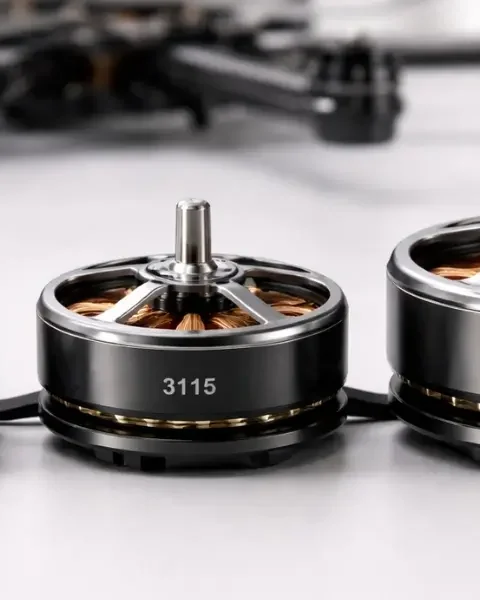
A BLDC motor converts electrical energy into mechanical rotation without the friction-prone brush contacts found in older DC designs. In a UAV context, the key performance parameters are tightly interdependent:
KV rating
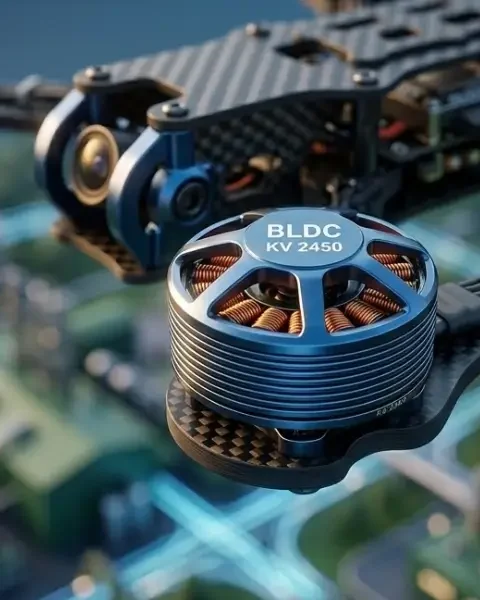
Expressed in RPM per volt (RPM/V), the KV rating governs how fast the motor spins at a given voltage. Lower KV motors run larger, slower propellers at higher efficiency — typical for long-endurance platforms. Higher KV motors suit smaller, faster-spinning propellers on racing or agile inspection drones.
Stator geometry
The stator winding configuration — defined by pole count and slot count — directly controls torque smoothness, cogging, and efficiency across the operating RPM range. A motor nominally rated at similar KV and wattage can perform very differently depending on stator design quality.
Magnet grade and bonding
Neodymium (NdFeB) magnets are standard in high-performance UAV motors. Magnet grade, coating quality, and bonding method have a significant impact on long-term reliability — particularly in high-vibration environments or when operating at temperature extremes common in outdoor deployments.
Bearing specification
Radial and axial load ratings, bearing preload, and seal specification matter enormously in multi-rotor applications where the motor supports propeller loads in all axes. Substandard bearings are one of the most common failure modes in commercially sourced brushless motors.
ENGINEERING NOTE: Many OEMs specify only KV rating and maximum continuous current when qualifying a motor supplier. This is insufficient. Stator lamination quality, winding wire gauge, and QC batch consistency are equally important — and much harder to verify from a datasheet alone. A qualified European BLDC motor manufacturer will provide full material traceability and acceptance test data at the lot level.
The current dependency: Europe’s reliance on Asian motor supply
The vast majority of brushless motors used in European-assembled drones originate from manufacturing clusters in Guangdong and Shenzhen provinces. This concentration developed for understandable reasons: the region hosts a dense ecosystem of component suppliers, CNC machining, winding automation, and low-cost assembly labour that delivered competitive pricing throughout the 2010s.
The result is that even OEMs who consider themselves “European manufacturers” are, in practice, assemblers of Asian-origin propulsion systems. This is not a criticism — it reflects the historical economics of the sector. But the risk profile of that model has changed materially.
Supply characteristic | Asia-dependent model | EU / diversified model |
Lead time (typical) | 14–36 weeks, container-dependent | 4–8 weeks, replenishable |
MOQ flexibility | High MOQs common; poor for low-volume OEMs | Lower MOQs with engineering flexibility |
Regulatory traceability | Limited; often unavailable to EN/AS standards | Full CoC and lot traceability available |
Customisation turnaround | 12–20 weeks for winding changes | 4–6 weeks with local engineering support |
Geopolitical exposure | High; tariff and export control sensitive | Low; EU regulatory environment |
Defence/dual-use eligibility | Increasingly restricted under EU/NATO frameworks | Available with appropriate certifications |
Risk landscape: what can go wrong — and already has
The risks of a single-region motor supply chain are not hypothetical. UAV OEMs across Europe have encountered several of the following disruptions in recent programme cycles:
Container shipping delays
The 2021–2022 shipping crisis demonstrated how container delays of 6–14 weeks could cascade into programme slippage and customer penalty clauses. Motors queued in ports cannot be replaced quickly when they are single-sourced from a distant supplier with 12-week MOQ lead times.
Quality batch variation
Several OEMs have reported significant inter-batch variation in motors from catalogue Asian suppliers — variation that is difficult to detect until integration testing, and almost impossible to trace without detailed lot-level QC data from the manufacturer.
Export control and dual-use classification
The EU’s updated dual-use regulation (2021/821) and subsequent national implementation measures have increased scrutiny on drone-relevant components, including high-performance BLDC motors. Procurement from non-EU suppliers serving defence or security programmes is an area of growing compliance complexity.
Tariff exposure
EU import tariffs on drone components from China have been subject to revision in the context of broader trade friction. A motor that was economically attractive at one tariff rate may no longer represent value at a revised rate, particularly when total landed cost (including freight, insurance, warehousing, and quality inspection) is properly accounted for.
IP and competitive sensitivity
Custom motor specifications developed in close collaboration with an Asian supplier carry inherent IP risk. The same winding configuration or magnet specification may appear in a competitor’s platform within months of development completion.
RISK SIGNAL: If your current motor supplier cannot provide: (1) lot-level material certificates, (2) winding and lamination inspection records, and (3) a confirmed lead time guarantee in writing — you are carrying unquantified supply risk in your programme schedule.
The case for a European BLDC motor manufacturer
The argument for sourcing brushless motors from a European UAV motor manufacturer rests on more than risk mitigation. There is a positive case for capability development, regulatory alignment, and partnership quality.
Regulatory alignment from the start
European motor manufacturers operate within the same regulatory environment as their OEM customers. CE marking, RoHS compliance, REACH substance declarations, and EN/ISO quality management systems are standard outputs — not expensive add-ons. For OEMs building platforms for U-Space operations or public safety use, this alignment removes a significant compliance burden from the supply chain qualification process. Our detailed breakdown of BLDC motor components explains what each part does and what to look for during supplier qualification.
Engineering proximity
Custom motor development benefits significantly from geographic and timezone proximity. A winding change, a shaft modification, or a connector re-specification can be turned around in days with an onsite visit rather than weeks of email chains across multiple time zones. For OEMs with evolving platform requirements, this engineering agility has tangible programme value.
Defence and security programme eligibility
A growing proportion of European UAV programmes — in border surveillance, critical infrastructure inspection, and military support roles — require supply chain components to meet country-of-origin requirements. EU-manufactured motors from qualified suppliers can satisfy these requirements in ways that Asian-sourced alternatives cannot.
Total cost of ownership
Unit price comparisons between Asian catalogue motors and European custom motors rarely capture total cost of ownership accurately. When freight, tariff, quality inspection, buffer inventory carrying costs, and the cost of supply disruption events are included, the European option is frequently cost-competitive — particularly at medium and high volumes.
KEY INSIGHT: The right comparison is not “catalogue price from China vs. European custom price.” It is “total delivered, qualified, programme-ready cost per flight hour” — a metric on which European sourcing performs significantly better than raw unit cost comparisons suggest.
What to look for in a European UAV motor supplier
Not all European brushless motor manufacturers are equivalent. When evaluating potential EU motor supply partners, procurement and engineering teams should assess the following:
In-house winding capability
A supplier who owns their winding process — rather than outsourcing to a third-party winder — offers better control over quality, lead time, and customisation. Ask whether winding is performed on-site, and what winding automation capability is in place.
Magnet sourcing and traceability
Most manufacturers — including European ones — source neodymium magnets from China. The key question is not origin, but traceability: can the supplier provide magnet grade certificates, coating specifications, and batch-level pull-force test data for every motor lot?
QMS certification
ISO 9001 is a minimum baseline. For OEMs serving aerospace, defence, or regulated inspection sectors, AS9100 certification or equivalent process discipline is a meaningful differentiator. Ask to see a recent audit summary.
Custom development process
Understand how the supplier handles custom specifications: What is the NRE cost structure? What are the minimum commitment quantities for custom windings? How are design changes tracked and communicated? A supplier with a defined custom development process will manage your programme timeline more predictably than one who treats customisation as an exception.
Capacity and scalability
Evaluate whether the supplier’s current capacity is consistent with your projected programme volumes — and whether they have a credible plan to scale. An excellent engineering partner who cannot commit to delivery of 5,000 units per year when you need them is not a long-term supply solution.
Evaluation criterion | What to ask | Minimum acceptable answer |
Winding process | “Is winding performed in-house?” | Yes, with documented process control |
Magnet traceability | “Can you provide batch-level magnet certificates?” | Yes, for every production lot |
QMS | “What quality certification do you hold?” | ISO 9001 minimum; AS9100 preferred |
Lead time guarantee | “What lead time do you guarantee in writing for repeat orders?” | Contractually committed, not indicative |
Custom MOQ | “What is your minimum order for a custom winding?” | Flexible, with NRE cost clearly separated |
Dual-use compliance | “Are you familiar with EU dual-use regulation 2021/821?” | Yes, with documentation process in place |
Securing your supply: practical steps for OEM procurement teams
For OEMs who have identified motor supply chain risk as a priority, the following practical steps provide a structured path to greater supply security without disrupting active programmes:
1. Conduct a supply chain audit
Map every motor variant used across your active platforms. Identify which are single-sourced, which have qualified alternatives, and which are custom specifications that would require re-qualification if switched. Quantify the revenue at risk for each single-source dependency.
2. Engage European suppliers in parallel — not as replacements
The fastest path to supply resilience is dual qualification: maintain your existing supply relationship while qualifying a European alternative. This eliminates the programme risk of a cold switch while building the supply base you need.
3. Prototype with custom intent
If you are specifying a new motor for a platform in development, build the custom specification around a European supplier’s capability from the start. This avoids the cost of re-qualification later and maximises the value of engineering proximity during development.
4. Negotiate buffer stock agreements
Ask your European motor supplier about consignment stock or vendor-managed inventory (VMI) arrangements. Holding 8–12 weeks of buffer stock at a local warehouse eliminates the lead time risk associated with long-distance sourcing.
5. Include supply security in your customer conversations
Increasingly, end customers — particularly in defence, utilities, and public safety — are asking about supply chain provenance as part of their procurement due diligence. An EU drone motor supply chain that you can document and demonstrate is a differentiator in competitive bids.
Summary
The EU drone motor supply chain is not a back-office procurement issue. It is a strategic capability question that affects programme reliability, regulatory compliance, competitive positioning, and — in the long term — European industrial autonomy in an increasingly important technology sector. To explore what a more secure sourcing model looks like for your platform, visit our supply security page or browse our motor products to see available specifications.
For UAV OEMs building platforms that matter, the brushless motor supply chain deserves the same level of engineering and commercial discipline as the platform itself. A qualified European BLDC motor manufacturer can provide the component quality, engineering proximity, regulatory alignment, and supply security that Asian catalogue sourcing cannot reliably offer.
The time to build that supply relationship is before the next disruption — not during it.
FAQ
What makes BLDC motors so critical in UAV supply chains?
Brushless DC motors are among the most mission-critical components in any UAV — they directly affect flight endurance, payload capacity, and system reliability. Unlike off-the-shelf parts, motor quality, consistency, and batch-to-batch variation can determine whether an OEM meets delivery commitments or faces programme slippage. If you’re new to how these motors work, our guide on what is a BLDC motor covers the fundamentals in detail.
Why are most drone motors still sourced from China, and is that changing?
The concentration of drone motor manufacturing in Guangdong and Shenzhen developed because of dense supplier ecosystems, low-cost assembly, and competitive pricing through the 2010s. However, geopolitical tensions, EU dual-use regulations, tariff changes, and post-pandemic shipping disruptions have shifted the risk profile significantly. European UAV OEMs are increasingly qualifying local alternatives to reduce single-region dependency.
What internal components should I evaluate when qualifying a brushless motor supplier?
Beyond KV rating and current rating, procurement teams should assess stator lamination quality, neodymium magnet grade and bonding, bearing specification, and winding wire gauge. Batch-level QC traceability is equally important and often overlooked.
How does the EU U-Space framework affect motor sourcing decisions?
U-Space requires operators and OEMs to demonstrate higher levels of component traceability across their platforms. Motors sourced from Asian catalogue suppliers often cannot provide the lot-level material certificates, CoC documentation, or RoHS/REACH compliance declarations that U-Space-aligned programmes require. European manufacturers operating under ISO 9001 or AS9100 frameworks are structurally better positioned to meet these requirements from day one.
How do I start building a more resilient drone motor supply chain without disrupting active programmes?
The safest approach is dual qualification — maintaining your existing supplier relationship while qualifying a European alternative in parallel. This avoids cold-switch programme risk while progressively building supply resilience. Buffer stock agreements and vendor-managed inventory (VMI) with a local supplier can further eliminate lead time exposure.