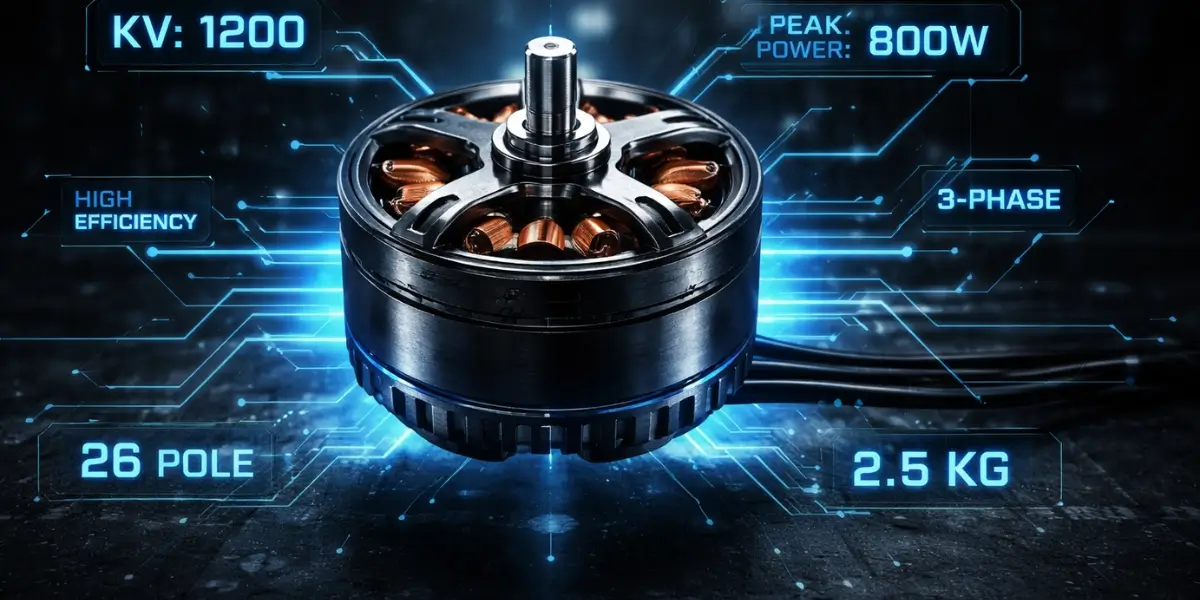
Introduction: Why Your UAV Motor Choice Can Make or Break Your Mission
Picture this: you’ve spent months designing a precision agricultural drone. The frame is perfect, the sensors are top-of-the-line, the software is flawless — but six minutes into the first field run, the motors overheat, thrust drops, and the drone comes down hard in the middle of a crop row. The culprit? The wrong UAV motor for the job.
It happens more often than people care to admit, and it’s almost always avoidable.
Selecting the right UAV motor is the single most consequential hardware decision you’ll make when building or sourcing a drone. Motors determine flight time, payload capacity, reliability in extreme conditions, and ultimately the commercial viability of your application. Whether you’re integrating motors into a 10 kg delivery drone or a 50 kg heavy lift industrial platform, the same core principles apply — but the tolerances and trade-offs are wildly different.
This guide cuts through the noise. We’ll walk you through every variable that matters: motor types, KV ratings, stator sizing, thrust calculations, application-specific selection, and how to evaluate a UAV motor manufacturer before you sign a purchase order. By the end, you’ll have a practical framework you can apply immediately — no engineering degree required.
What Is a UAV Motor?
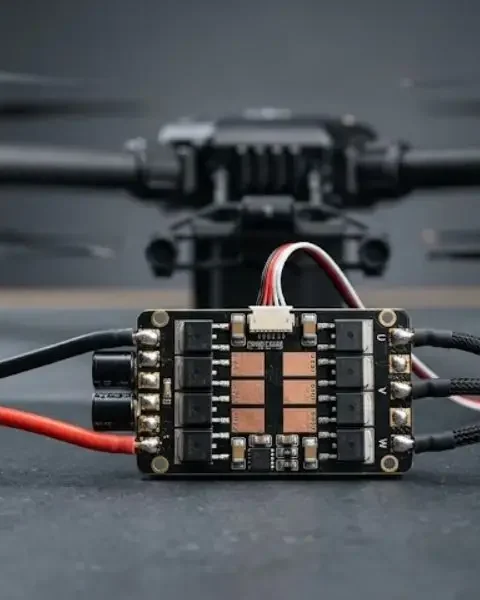
A UAV motor is an electric motor specifically designed or adapted to spin propellers in an unmanned aerial vehicle. It converts electrical energy from the battery into rotational mechanical energy, generating thrust when paired with a propeller. Together with the ESC (Electronic Speed Controller), battery, and propellers, the motor forms the core of any drone propulsion system.
Unlike motors in ground vehicles, UAV motors must achieve an extremely delicate balance: they need to be lightweight enough not to compromise payload, powerful enough to generate meaningful thrust, and efficient enough to maximize battery endurance — all while surviving vibration, temperature swings, dust, moisture, and continuous load cycling.
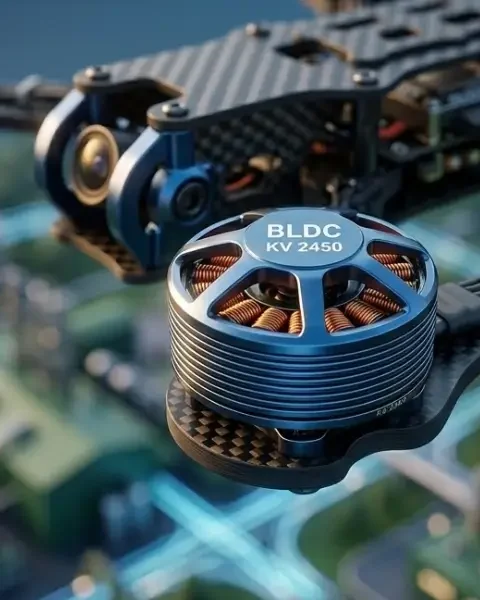
In modern drones, the dominant motor type is the Brushless DC (BLDC) motor, valued for its high efficiency, low maintenance, and exceptional power-to-weight ratio. If you want to understand the underlying technology in detail, this deep-dive on BLDC motors is worth reading before you go further.
Types of UAV Motors
Brushed vs. Brushless Motors
Brushed motors use physical carbon brushes to transfer current to the rotor. They’re simple and cheap, but the brush-commutator interface creates friction, heat, and wear. They’re largely limited to toy-grade drones and low-cost hobby platforms.
Brushless DC (BLDC) motors are the industry standard for any serious UAV application. Electronic commutation replaces the mechanical brushes, dramatically improving efficiency (typically 85–92%), reducing heat generation, and extending motor life to tens of thousands of hours under normal operating conditions. Explore a full breakdown of BLDC motor components to understand what’s inside.
Industrial Drone Motors vs. Hobby Motors
Industrial drone motors are engineered for durability, repeatability, and mission-critical reliability. They are manufactured to tighter tolerances, use higher-grade magnets (often N52 neodymium), feature reinforced stator windings, and are tested extensively before shipping. They also carry certifications relevant to professional drone operations.
Hobby motors are cost-optimized and fine for recreational flying, but they lack the quality control and documentation needed in commercial or regulatory contexts. For any drone operating commercially — agriculture, inspection, logistics — industrial drone motors are the only sensible choice.
Heavy Lift Drone Motors vs. Small Drone Motors
Heavy lift drone motors are large-diameter, low-KV motors designed to spin large propellers (18–40+ inches) at moderate RPMs, generating the massive thrust needed to lift payloads of 10–100 kg. They require robust ESCs and high-voltage battery systems (typically 12S–24S LiPo or LiNMC).
Small drone motors (used in sub-5 kg platforms) are compact, higher-KV motors spinning smaller props. They emphasize agility and responsiveness over raw lifting power.
Key Factors for UAV Motor Selection
KV Rating Explained
KV is the most misunderstood spec in UAV propulsion. It expresses how many RPM a motor produces per volt of input with no load. A 400 KV motor running on a 48V system will spin at approximately 19,200 RPM unloaded. Under real load with a propeller, actual RPM will be lower.
The key insight: lower KV = higher torque = larger prop = more thrust per watt. High-KV motors spin fast but require small, light props and are better suited to agile racing or small commercial drones. Heavy lift and agricultural drones should use low-KV motors (80–400 KV) to maximise efficiency with large propellers. Read more about KV rating selection for BLDC motors before locking in a spec.
Thrust Requirements
Thrust is measured in grams (g) or kilograms (kg) of force. Each motor must produce enough thrust to lift its share of the total aircraft weight — including the frame, batteries, payload, and a safety margin. As a general rule, your total thrust capacity should be at least twice the all-up weight (AUW) of the aircraft for stable flight.
Propeller Compatibility
Motor and propeller are a matched system. The motor’s KV, stator size, and torque characteristics must be matched to the propeller’s diameter and pitch. Mismatching leads to excessive current draw, heat, reduced efficiency, or motor failure. Always reference the motor manufacturer’s recommended propeller range.
Voltage and Battery Matching
More voltage means more power for a given current. Industrial UAV platforms increasingly run on 12S (44.4V) or higher to deliver more power without increasing current — which reduces cable heating losses and allows smaller wire gauges. Ensure your motor’s maximum voltage rating exceeds the battery’s peak voltage.
Efficiency and Power Consumption
Motor efficiency at your operating thrust point directly determines flight endurance. A motor that runs at 88% efficiency at hover thrust will extend battery life significantly compared to one running at 78%. Request efficiency curve data from your motor supplier — not just peak efficiency, but efficiency at your actual operating point (typically 40–60% throttle for multirotors in hover).
Motor Size and Weight
Every gram on the motor is a gram subtracted from payload capacity. Industrial platforms make careful trade-offs here. Don’t spec the heaviest motor that generates enough thrust — find the one that hits your thrust target at the lowest weight, with sufficient thermal headroom.
Cooling and Durability
Overheating is the primary cause of in-service motor failure. Look for motors with ventilated bell housings, high-temperature winding insulation (Class F or H), and if operating in high-ambient environments (agriculture in summer, Middle East deployments), consider active cooling options. IP-rated motors are essential for agricultural and maritime applications.
Understanding Motor Size Codes
UAV motors are commonly identified by a four-digit code that describes the stator dimensions — the most critical physical parameter governing performance.
- First two digits: Stator diameter in millimeters
- Second two digits: Stator height (stack height) in millimeters
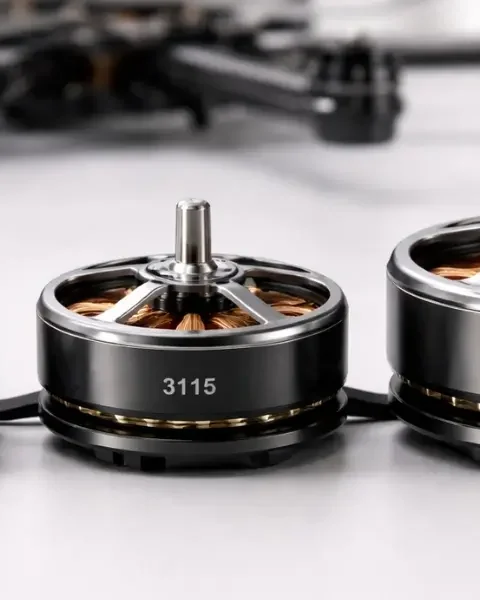
Example: A 3110 motor has a 31 mm stator diameter and a 10 mm stator height. A 5006 has a 50 mm diameter and 6 mm height. Larger diameter generally means more torque capacity; taller stator means more power output.
Wider stators produce more torque at lower RPM — ideal for large propellers on heavy-lift platforms. Taller stators increase power density, useful when you need more thrust without increasing the motor’s footprint. For a direct technical comparison of popular sizes, see this detailed breakdown of 3110 vs 3115 vs 5006 UAV motors.
| Motor Code | Stator Ø (mm) | Stator H (mm) | Typical Prop Range | Best Application |
|---|---|---|---|---|
| 2212 | 22 | 12 | 8–10 in | Small racing / inspection drones |
| 3110 | 31 | 10 | 12–15 in | Mid-size commercial drones |
| 3115 | 31 | 15 | 13–17 in | Agricultural / delivery drones |
| 5006 | 50 | 6 | 18–24 in | Heavy lift platforms |
| 6010 | 60 | 10 | 22–32 in | Industrial heavy lift (>25 kg) |
| 8010 | 80 | 10 | 28–40 in | Very heavy lift / cargo drones |
Choosing Motors Based on Application
Agricultural Drones
Agricultural spraying drones carry heavy liquid payloads (10–30 L tanks) that change in weight throughout the mission. Motors must handle dynamic load variation, operate in humid and dusty environments, and run near-continuously for hours. Low-KV motors (120–280 KV) with IP ratings and high-temperature windings are standard. Efficiency at partial throttle is critical — these drones spend most of their flight time at moderate, not maximum, thrust.
Surveillance and Inspection Drones
ISR and inspection platforms prioritise endurance and stability over raw lift. Lower disc loading (larger props, slower RPM) extends flight time. These applications often use mid-range KV motors (300–600 KV) on 6S–10S systems, optimised for loiter efficiency rather than speed or payload.
Delivery Drones
Delivery UAV propulsion must balance payload capacity, aerodynamic efficiency, and rapid acceleration for responsive navigation. Variable-pitch systems are gaining ground here, but most current commercial delivery platforms use fixed-pitch BLDC motors in the 150–350 KV range on 12S systems, with redundant motor pairs for safety.
Heavy Lift Industrial Drones
Construction, film, and emergency response platforms carrying 15–80 kg require the most demanding motor specs: large-diameter stators, ultra-low KV (80–180 KV), high-voltage systems (18S–24S), and robust thermal management. Redundancy (8–12 motors vs. the typical 4–6) and real-time telemetry on motor temperature and current are non-negotiable for safe operations. Understanding the supply security for such critical components is equally important.
Thrust-to-Weight Ratio
Thrust-to-weight ratio (TWR) is the single most useful number for evaluating whether your motor selection will actually work. It’s simple: total maximum thrust divided by total aircraft weight.
- 2:1 TWR — Minimum for stable multirotor flight. The aircraft can hover at 50% throttle, leaving 50% for control authority and gusts.
- 3:1 TWR — Recommended for commercial applications. Provides comfortable margins, handles payload variation, and allows aggressive manoeuvring if required.
- 4:1+ TWR — Racing and acrobatic drones. Overkill for most commercial platforms and costly in terms of motor weight and power system complexity.
How to Estimate Required Thrust
- Weigh (or estimate) the complete aircraft including battery and maximum payload.
- Multiply by your target TWR (use 2.5 for a safe commercial baseline).
- Divide by the number of motors to get per-motor thrust requirement.
- Select a motor whose thrust at the propeller you plan to use exceeds this value, ideally by 20%.
Example: A 12 kg delivery drone with a 2.5:1 TWR target needs 30 kg total thrust. On a hexacopter (6 motors), each motor must produce at least 5 kg of thrust. You’d select motors rated at 6+ kg thrust with your chosen propeller to maintain a comfortable margin.
Common Mistakes to Avoid
| Mistake | What Goes Wrong | How to Avoid It |
|---|---|---|
| Wrong KV selection | Overspeeding props, excessive current draw, motor overheat, short flight time | Match KV to prop diameter and voltage system; use manufacturer charts |
| Ignoring propeller matching | Inefficient thrust, resonance vibration, premature failure | Use motor maker's recommended prop list; validate with bench testing |
| Overloading motors | Thermal runaway, winding burnout, mid-flight failure | Maintain ≥20% thrust margin; monitor motor temp via telemetry |
| Ignoring the ESC pairing | ESC failure, desync, erratic throttle response | Always use an ESC rated above the motor's peak current; read the BLDC controller guide |
| Skipping IP rating for harsh environments | Moisture or dust ingress causes winding shorts | Specify IP55 or higher for agricultural and outdoor industrial use |
| Sourcing without supply chain visibility | Counterfeit parts, delayed lead times, no support | Work with certified UAV motor manufacturers; understand the global supply chain landscape |
How to Choose a UAV Motor Manufacturer
The motor manufacturer you choose is as important as the motor itself. Here’s what to look for:
Quality Standards and Certifications
Look for ISO 9001-certified manufacturing processes, RoHS compliance, and ideally CE/FCC certifications where relevant. A manufacturer that can’t produce quality documentation is a red flag for commercial procurement.
Traceability and Testing
Every motor destined for commercial UAV use should come with test data: thrust curves, efficiency curves at multiple operating points, and evidence of 100% final inspection. Batch-level traceability — knowing exactly which production run a motor came from — is essential for fleet operators who need to investigate failures or implement proactive maintenance.
Customisation Capability
Standard off-the-shelf motors rarely hit every performance target for a specialised UAV platform. A capable UAV motor manufacturer should offer winding customisation (to optimise KV for your exact voltage/prop combination), shaft and mounting adaptations, and custom connectors or cable runs. Explore Centrion Systems’ motor range to see what a specification-flexible industrial supplier looks like in practice.
After-Sales Support
Industrial drone programs run for years. Your motor supplier needs to guarantee supply continuity, provide engineering support for design integration, and commit to a spare parts programme. Before placing a large order, ask explicitly: what’s the EOL (end-of-life) policy, and what’s the guaranteed delivery lead time for replacement units? Learn more about Centrion Systems‘ commitment to long-term customer partnerships.
Future Trends in UAV Motors
Higher Efficiency Through Advanced Magnetics
Next-generation UAV motors are adopting higher-grade rare earth magnets, hairpin winding designs borrowed from automotive EV motors, and silicon carbide (SiC)-based ESC technologies. These changes are pushing system efficiencies above 94% — a meaningful gain when flight endurance is the constraint.
Smart Propulsion Systems
Integration between motor, ESC, and flight controller is deepening. Smart motors with embedded temperature, current, and vibration sensors enable real-time health monitoring, predictive maintenance alerts, and adaptive power management. For fleet operators, this data feeds into maintenance scheduling systems that prevent failures rather than reacting to them.
Variable-Pitch Propulsion
Fixed-pitch BLDC systems dominate today, but variable-pitch propulsion — where blade angle changes instead of RPM — is gaining traction for heavy-lift applications. Variable-pitch systems respond faster, allow more precise load sharing across motors, and can operate motors at a constant, thermally stable RPM regardless of thrust demand.
Hybrid Propulsion
For long-range and heavy payload applications where battery energy density is a fundamental limit, hybrid propulsion systems (combustion generator + BLDC motors) are an emerging architecture. The UAV motor’s role here shifts: motors must handle variable bus voltage and integrate with sophisticated power management electronics.
FAQ
What KV rating should I choose for an agricultural spraying drone?
Agricultural spraying drones typically run best with motors in the 120–280 KV range on 12S–18S battery systems. Lower KV allows the use of large-diameter, high-efficiency propellers (18–28 inches) that provide the lift needed for heavy liquid payloads while minimising power consumption. Your exact KV choice should be validated against your specific propeller diameter and battery voltage using the motor manufacturer’s thrust data.
What is the difference between a 3110 and a 5006 UAV motor?
A 3110 motor has a 31 mm stator diameter and 10 mm height, suited to mid-size commercial drones with 12–15 inch propellers. A 5006 has a larger 50 mm diameter with a 6 mm height, designed for heavy-lift platforms using 18–24 inch propellers. The 5006’s wider stator generates significantly more torque at lower RPM, enabling greater thrust per watt with large props. See the full comparison for detailed specs
How do I calculate how much thrust my drone needs?
Multiply your drone’s maximum all-up weight (AUW) — frame, battery, motors, payload — by your target thrust-to-weight ratio (2.5 is a safe commercial baseline). Then divide by the number of motors. For example: a 15 kg drone with 6 motors at 2.5:1 TWR needs each motor to produce at least 6.25 kg of thrust. Always add a 15–20% margin for propeller efficiency losses and real-world variability.
Can I use hobby drone motors for industrial applications?
It’s strongly inadvisable. Hobby motors lack the quality control, documentation, and durability certifications required for commercial UAV operations. They’re manufactured to cost targets, not performance consistency targets. For any drone operating commercially — particularly agricultural, inspection, or delivery platforms — industrial drone motors with proper traceability, testing data, and warranty support are the minimum acceptable standard.
How important is motor efficiency, and how do I compare it?
Motor efficiency directly determines how long your drone can fly. A 5% improvement in motor efficiency at hover thrust can add 10–15% to total flight time — significant for commercial operations. When comparing motors, don’t just look at peak efficiency; ask for efficiency at your expected operating thrust point (typically 40–60% of maximum thrust for hovering platforms). Efficiency curves across the full throttle range are the gold standard for motor comparison.
What should I ask a UAV motor manufacturer before buying?
Key questions include: Can you provide full thrust and efficiency curves with our specific propeller? What is your quality certification (ISO 9001)? Do you offer batch-level traceability? What is the thermal limit of the motor and at what ambient temperature? Can you customise the winding KV for our battery voltage? What are your lead times and spare parts availability commitments? The answers will quickly reveal whether you’re dealing with an industrial-grade supplier or a rebranding operation.
What is the ideal thrust-to-weight ratio for a commercial delivery drone?
A minimum 2:1 ratio is required for stable flight, but commercial delivery drones should target 2.5:1 to 3:1. This provides sufficient authority to handle wind gusts, maintain precise hover for delivery positioning, and manage the significant weight change that occurs when a package is dropped. Higher TWR (above 3:1) is generally unnecessary for delivery applications and adds motor weight that subtracts from payload capacity.
Conclusion: Make Your UAV Motor Selection Count
Choosing the right UAV motor isn’t a minor procurement decision — it’s a foundational engineering choice that determines whether your drone meets its performance targets, stays in the air reliably, and makes economic sense over its operational lifetime.
The framework is straightforward once you internalise it: start with your application requirements (payload, endurance, environment), calculate your thrust needs, select the stator size and KV that hits those targets at your battery voltage, validate propeller compatibility, and then evaluate manufacturers on quality, traceability, and long-term support.
Avoid the common traps — wrong KV, unmatched propellers, sourcing from unverified suppliers — and you’ll avoid the majority of motor-related failures seen in commercial drone programs today.
Whether you’re designing a precision agricultural drone, a heavy lift industrial platform, or a last-mile delivery system, the drone propulsion system you build around the right UAV motor will define what your drone is actually capable of. Get it right, and everything else becomes easier.
For further reading, explore Centrion Systems’ full resource library at centrionsystems.com, or browse the industrial motor product range to see specifications built for real commercial UAV programs.
Looking for EU-made BLDC motors for your UAV platform?
Centrion Systems designs and manufactures BLDC outrunner motors in the Netherlands. Built for professional UAV applications with full EU supply chain security.